Why Putting 20 Percent Down on Your Next Home May Be Worth It
- WWH

- 2 days ago
- 5 min read
A 20% down payment is not required for many homebuyers. That part is true. But if you already own a home and plan to buy again, putting 20% down on your next place can still be a smart move.
Many repeat buyers are in a different position than first-time buyers. They have years of mortgage payments behind them, and in many cases, years of home price growth working in their favor. That can create equity, which may give them more options when it is time to move.
The question is not whether every buyer needs to put 20% down. They do not. The better question is whether putting more down gives you enough benefits to make it worth considering.
For many repeat buyers, the answer may be yes.
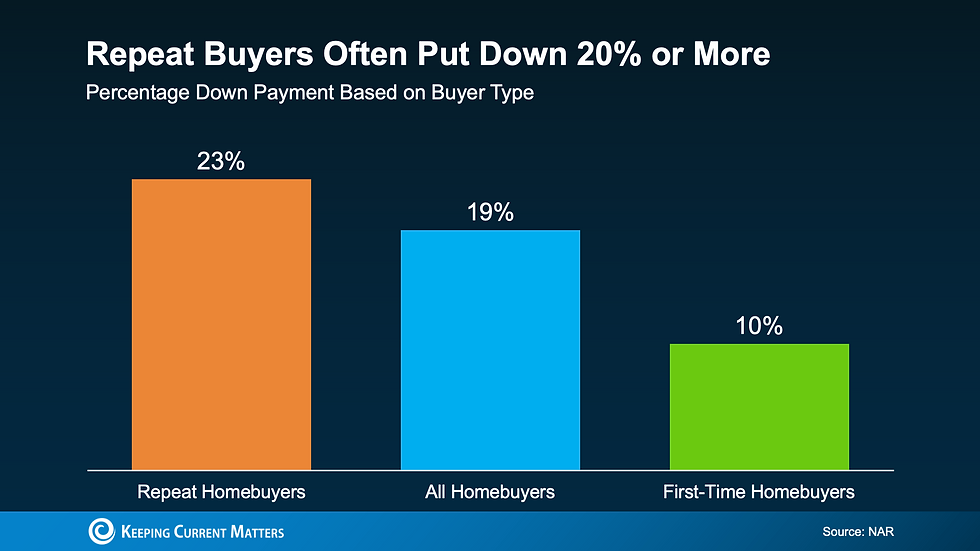
Repeat buyers often have more cash to work with
According to the National Association of Realtors, the typical repeat buyer puts down 23% when buying a home. That is much higher than the typical first-time buyer down payment, which NAR has reported at around 10%.
That gap usually comes down to one thing: home equity.
Home equity is the difference between what your home is worth and what you still owe on your mortgage. If your home is worth $450,000 and you owe $250,000, you have about $200,000 in equity before selling costs and any other expenses.
Equity can grow in two main ways:
You pay down your mortgage balance over time.
Your home rises in value.
That does not mean every homeowner has a large amount of equity. Local prices, loan terms, market timing, and how long you have owned the home all matter. But many homeowners who bought several years ago may have more equity than they realize.
When they sell, that equity can turn into cash. Some of it may go toward moving costs, repairs, fees, or paying off other debt. But for many repeat buyers, a large portion goes straight into the down payment on the next home.
That is why putting 20% down may feel out of reach for a first-time buyer but realistic for someone selling a current home.
A larger down payment can lower your monthly payment
One of the clearest benefits of putting 20% down is a smaller loan balance.
If you buy a $500,000 home and put 10% down, your loan amount is $450,000. If you put 20% down, your loan amount is $400,000. That $50,000 difference affects your monthly principal and interest payment.
A lower loan amount can make the payment easier to manage, especially when mortgage rates are higher than they were a few years ago.
That matters because the mortgage payment is only one part of owning a home. You may also have:
Property taxes
Homeowners insurance
Utilities
HOA dues, if applicable
Maintenance and repairs
Possible upgrades after moving in
A lower payment can create breathing room in your monthly budget. It may also make it easier to handle the unexpected, such as a roof repair, appliance replacement, or higher insurance premium.
Putting 20 percent down on your next home may be worth it if it helps you buy comfortably instead of stretching your budget to the edge.
You may avoid private mortgage insurance
Another major benefit of putting 20% down on a conventional loan is that you can often avoid private mortgage insurance, known as PMI.
PMI is usually required when a buyer puts less than 20% down on a conventional mortgage. It protects the lender, not the buyer, if the borrower stops making payments.
The cost of PMI varies based on factors like credit score, loan amount, and down payment size. But even when it is not huge, it is still another monthly expense.
Avoiding PMI can make a real difference. It may help:
Reduce your monthly payment
Improve your overall housing budget
Keep more money available for savings or repairs
Make the loan feel less costly over time
For some buyers, PMI is a reasonable trade-off if it allows them to buy sooner. For repeat buyers with enough equity, avoiding it can be one of the strongest reasons to put more down.
A stronger offer may help in a competitive market
A larger down payment can also make your offer look stronger to a seller.
Sellers want confidence that the deal will close. A buyer putting more money down may appear more financially prepared. That can matter if the seller is comparing multiple offers.
A higher down payment does not guarantee your offer will win. Price, contingencies, closing timeline, appraisal terms, and the seller’s specific needs all play a role. But it can help signal that you are a serious buyer with solid financing.
This can be especially helpful if you are buying and selling at the same time. Sellers may look closely at whether you can complete both transactions smoothly. A stronger financial position can make your offer more appealing.
More equity can protect you after you buy
Putting more down also gives you a larger equity cushion from day one.
That matters because home values can move up and down. Real estate is usually a long-term asset, but short-term price changes can happen. If you buy with very little down and home values dip, you may have little equity for a while.
With 20% down, you start with more ownership in the home. That can give you more flexibility if life changes and you need to sell sooner than expected.
A stronger equity position may also help later if you want to refinance, remove mortgage insurance, or tap home equity for a major expense. Those choices depend on market conditions and lender rules, but more equity often creates more options.
When putting 20% down may not be the best move
A bigger down payment has clear benefits, but it is not automatically the right choice for everyone.
If putting 20% down drains your savings, that can create risk. A home purchase comes with costs beyond the down payment. You may need cash for closing costs, movers, repairs, furniture, or temporary overlap between homes.
It is usually wise to keep an emergency fund after closing. Owning a home without cash reserves can feel stressful, even with a lower mortgage payment.
A smaller down payment may also make sense if you have better uses for the money, such as paying off high-interest debt or keeping funds available during a job change. The right choice depends on the full financial picture.
Here are a few questions to ask before deciding:
Will you still have savings after closing?
How much would 20% down lower your monthly payment?
Would it help you avoid PMI?
Are you buying in a competitive market?
Do you need cash for repairs or updates?
How long do you expect to stay in the home?
A lender can help compare loan scenarios, and a financial advisor can help weigh the trade-offs. This article is for informational purposes only and is not personal financial advice.
The bottom line
Putting 20% down is not a rule every buyer has to follow. Plenty of buyers use low-down-payment loans successfully.
But repeat buyers often have an advantage that first-time buyers do not: equity from their current home. If selling gives you enough cash to put 20% down and still keep a healthy cushion, the benefits can be meaningful.
You may lower your monthly payment, avoid PMI, strengthen your offer, and start your next chapter with more equity from day one.
The best next step is simple: find out how much equity you have, then compare what your next purchase would look like with different down payment amounts. The right number is the one that helps you move forward with confidence, not just the one that sounds traditional.


Comments